
Explained: the round of 32
Plus: Canadian dreamland, the player too fat for soccer (and how he turned it around), and the Ronaldo & Messi showdown is over

Welcome to The Tap-Inn. Where you can tap into the world of soccer with me, your Irish Tap-Inn bartender, Joe. 🍻
Pull up a stool. The group stage is done, the knockouts are here, and the World Cup just got real. Here's what's on tap today:
🤔 The last 32, explained
🏆 Canada make history with their first-ever knockout win at a World Cup
💸 Do players actually get paid to turn out for their country?
Let’s tap in.
⚽ GOAL OF THE WEEK
A fortnight ago, Canada had never won a single World Cup game. Not one in their whole history.
Since then they've qualified second in their group, and yesterday, on a day Canadian soccer fans will never forget, they went and won a knockout tie. Stephen Eustáquio buried it deep in stoppage time against South Africa to send Canada into the last 16. Watch the scenes here:

Molson Canadian stocks going through the roof 📈📈📈
🥃 TOP SHELF
Welcome to the last 32

A good day to be Canadian (credit: Yahoo Sport)
Welcome to the knockout rounds of the World Cup. The group stage is done, the 32 survivors are confirmed, and the bracket is set. Here's how we got here and what happens next:
48 teams entered across 12 groups of four. The top two from each group went through automatically — that's 24 teams.
The remaining eight spots went to the best third-place finishers across all 12 groups. Finish third and you could still survive — but only if your points, goal difference and goals scored ranked you among the eight best third-placers in the tournament.
The bracket is now fixed. No redraws, no reseeding. Every team already knows the exact road they have to reach the final.
Win this week and you're in the Round of 16. Lose and you're on the next flight home.
Simple enough. But here's where it gets different from the group stage.
In the group stage, a draw (tie) was fine. Two teams could play 90 minutes, shake hands at 1-1, take a point each and walk off perfectly happy. That's gone now. From here it's winner-takes-all, survive and advance, just like the NFL playoffs. One bad afternoon and your tournament is over.
“What happens if a game is still tied after 90 minutes?”
I thought you might ask that…
Extra time
Two additional 15-minute halves, played out in full regardless of the score. Legs turn to concrete, cramp sets in, and a fresh substitute coming off the bench can suddenly look like the only man on the pitch still able to run. Thirty more minutes to find a winner — and if nobody can, then it goes to penalties.
What's worth knowing is that extra time wasn't always played to the finish. From 1993 to 2004, there was a thing called the golden goal. Sudden death in soccer terms. Score in extra time and the game ended immediately. No second half, no reply. Just the whistle, and someone's tournament was over.
It produced some extraordinary moments. Germany won Euro 96 with one. France won Euro 2000 with one. Stop-your-heart stuff. But it backfired completely. The golden goal was meant to make extra time more enjoyable; force teams to go for the throat. Instead it had the opposite effect. Everyone got so terrified of conceding the goal, they stopped attacking altogether. Sat deep, protected the box, and prayed for penalties. They scrapped it in 2004, and it's never come back.
⏰ TLDR: Group stages are done. 32 teams left. Teams have to win or go home. If it’s a tie, we go to extra time. Still a tie after extra time? Penalties.
Pull your stool a little closer people, things are getting serious.
🌎 SOUND LIKE A PRO
“The business end”
Origin: The business end of any tool is the part that actually does the work, the sharp end of a knife, the pointy end of a spear. Sportswriters borrowed it to mean the stage of a competition where things get serious and the stakes get real.
Definition: The knockout phase. No more dead rubbers, from here on it's win or go home.
Usage: "The group stage is for getting through. But now we're at the business end of the World Cup, that's where things get serious."
The Last Time Stocks Were This Expensive Was December 1999.

"Right now, it's good. But it was in '72, '86, 2000, and 2007." - Jamie Dimon, May 2026.
The Shiller CAPE ratio just hit 42.3. The only time in 140 years it's been higher? December 1999.
Stocks can stay expensive for a long time...
It’s one metric to consider, but when your portfolio is built around the most expensive equities in modern history, what else you diversify with could really matter.
Blue-chip contemporary and post war art has shown near-zero correlation with the S&P since 1995.* Prices are largely driven by private collectors competing for a fixed supply of artwork by artists like Banksy, Basquiat, and Picasso.
Masterworks lets you invest in shares of that market.
$1.3B deployed across 500+ artworks
29 exits to date
Net annualized returns like 16.5%, 17.6%, and 17.8%, not including those unsold
*According to Masterworks data. Investing involves risk. Past performance is not indicative of future returns. See important Reg A disclosures at masterworks.com/cd.
🗞️ THE WORLD CUP TAP-IN
The top pour

Me when the customer starts drinking their Guinness before it has settled
With the 72-game group stage finally over, here’s a quick look back at the winners and losers of the 2026 World Cup so far.
Top of the class? Cape Verde. An island nation of barely 500,000 people, at their first ever World Cup, drew all three games and stonewalled the mighty Spain. They're now the smallest country ever to reach the knockouts. Their prize? A date with Messi's Argentina.
The big names didn't all keep up though. Uruguay, two-time world champions, fluffed their lines and are already booking flights home. Their coach was pretty chillabsolutely furious at least. And spare a thought for Türkiye, a fashionable pick to win their group, who fired off 62 shots in their first two games and scored none of them. Out before they'd even played their final group game.
But here's the real heartbreaker. Portugal could only draw with Colombia in their final group game, dropping them to second and onto the opposite side of the bracket from Argentina. Translation: the Messi vs Ronaldo quarterfinal we all dreamed of is dead. The only place these two legends can meet now is the final, July 19.
Two decades of rivalry, down to one last maybe. Pour a stiff one.
WC specials
The field is down from 48 teams to 32 and the knockouts are open for business. Here's last orders from the weekend that was.
France 4-1 Norway (Fri June 26, Gillette Stadium, Boston): Billed as a Haaland vs Mbappé shootout, it turned into the Ousmane Dembélé show. The reigning Ballon d'Or winner had his hat-trick wrapped up inside 32 minutes, while Haaland watched from the bench. France took the group with a perfect nine points and suddenly look very dangerous.
Cape Verde 0-0 Saudi Arabia (Fri June 26, NRG Stadium, Houston): Here's a stat to chew on: Cape Verde reached the knockouts without winning a single game. Three draws, three points, second in the group. This goalless one did the job, finishing them above two-time champions Uruguay, who lost to Spain and crashed out.
Argentina 3-1 Jordan (Sat June 27, AT&T Stadium, Dallas)
Scaloni rested Messi, then sent him on for the last half hour. With 10 to play he curled in a low free kick. That's six goals this tournament, a record 19 all-time, and a record seventh straight World Cup game on the scoresheet. The fella is 39.
Next on the menu
Things are getting spicy. Here’s the pick of the bunch over the next few days.
USA vs Bosnia & Herzegovina (Wed July 1, 8pm ET, Santa Clara): The one you've circled. The USMNT won their group and now face Bosnia for a spot in the last 16. Win or fly home, no group-stage safety net this time.
France vs Sweden (Tue June 30, 5pm ET, MetLife): Dembélé is flying for 2022 finalists France. 1958 finalists Sweden will answer with Isak and Gyökeres. Something has to give.
Mexico vs Ecuador (Tue June 30, 9pm ET, Estadio Azteca): Co-hosts Mexico at the iconic Azteca. Mexico are the only team at the World Cup who have won all 3 games and conceded 0 goals. But Ecuador knocked off Germany in the group stage, so this comes with a warning label.
🌎 BAR CRAWL AROUND THE WORLD
Team Preview: Bosnia & Herzegovina

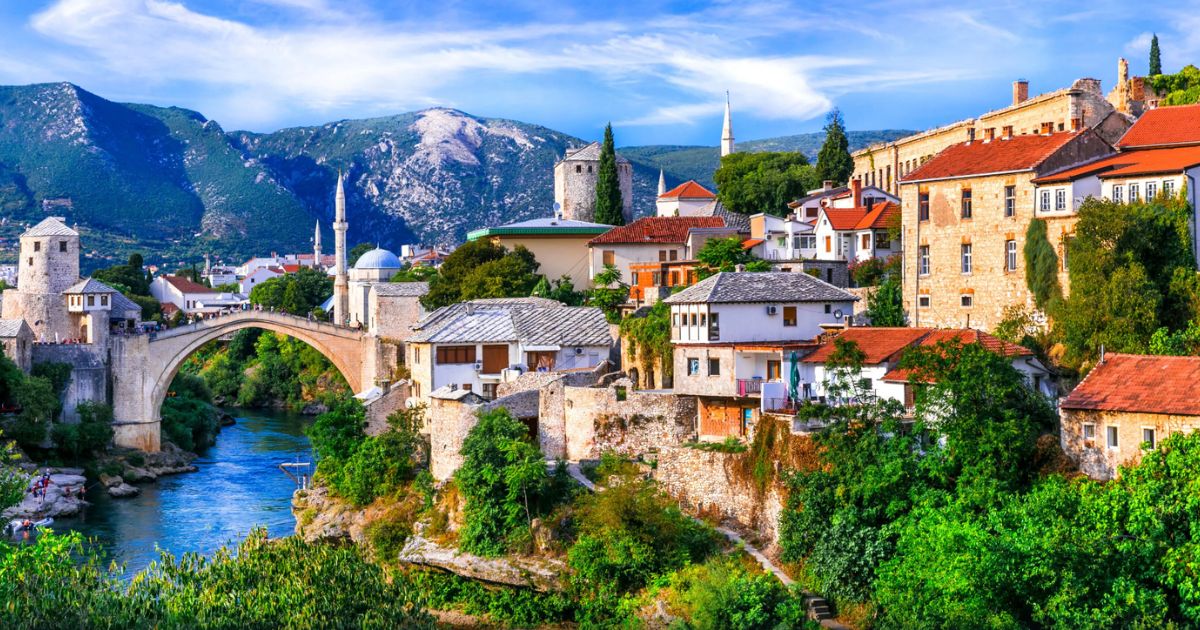
The most AI-looking city I’ve ever seen
Best World Cup finish: Group stage, 2014. Bosnia's only appearance ended in heartbreak after a wrongly disallowed Edin Džeko goal against Nigeria. Even the referee later admitted the mistake.
Star player: Edin Džeko. Still leading the line at 40, Bosnia's record scorer (73 goals) is back for one last dance.
Joe's favorite city: Mostar (above). A stunning stone bridge, crystal-clear river, cobbled streets and some of the best ćevapi you'll ever eat.
Top-selling beer: Sarajevsko. Brewed since 1864, its brewery became a vital source of drinking water during the Siege of Sarajevo. A beer that helped keep a city alive.
PS here it is on a map (you’re welcome).
📝 ASK JOE
“I know soccer players get paid a fortune to play for their clubs, but do they get paid to play for their country?”
Thanks to Sarah from Chicago for this great question.
In short, yes — most countries pay their players for representing their nation. For the elite lads on the eye-watering salaries, it's more of a stipend. What makes it interesting is where the money comes from.
FIFA pays the federations, not the players directly. Every country gets at least $12.5 million just for showing up, rising to $50 million for the winners. Each federation covers its costs, then decides how much filters down to the squad.
Take the US — their players have a deal where prize money is split equally, men's and women's teams included. A group stage exit nets each player around $330,000. Win the whole thing and that's close to $1 million a head.
🔥 QUICKFIRE

Korea 🤝 Mexico
Underdog of the week
Ismael Saibari, too fat to play soccer?
Ismael Saibari was born with a condition that made him unable to walk unaided when he was a child. When he was a teenager, Anderlecht told him he was too overweight and released him from his contract. He bounced through three more clubs, turned down Belgium's national team to represent Morocco instead, and arrived at this World Cup largely unknown outside the Netherlands.
He won't be unknown much longer. Two goals in Morocco's opening two games — the second after just 71 seconds, the fastest in his country's World Cup history. Bayern Munich are reportedly interested in signing him. This is a man I would not bet against.
Fanzone
Mexico and Korea, the unlikeliest of friendships
The bond between these two fanbases goes back to 2018. Korea knocked Germany out of the World Cup, a result that sent Mexico through. When the final whistle went, hundreds of Mexican fans marched straight to the South Korean embassy in Mexico City, hauled the consul general onto their shoulders, and made him drink tequila from the bottle while chanting "Coreano, hermano, ya eres Mexicano" — Korean brother, you are now Mexican.
Eight years on, that friendship is very much alive. The two sets of fans have been sharing food, swapping chants and squaring up for Gangnam Style dance-offs in packed bars.
Last call
In Mexico's final group game, score long settled, the Azteca crowd started chanting one name: O-cho-a. In the 77th minute the manager obliged and sent on 40-year-old goalkeeper Guillermo Ochoa for his sixth World Cup, on the very pitch where he made his debut as a teenager in 2004. Eighty-five thousand people roared. His teammates threw him in the air at the whistle.
Six World Cups puts him level with Messi and Ronaldo. Not bad for a keeper they wrote off as too old years ago.
As they say in Bosnia and Herzegovina, živjeli! 🍻
Share with a friend link.